Showing posts with label communism. Show all posts

Tuesday, June 3, 2008

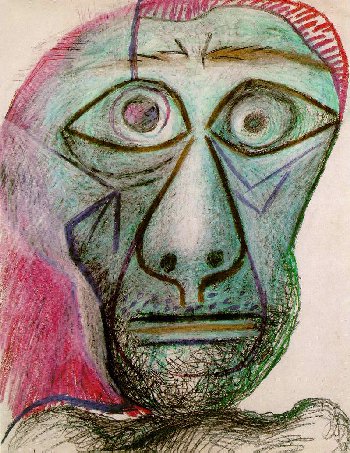
For Obama, Picasso's Surrealism Has Strong Aesthetic & Political Undertones: What Would 'Reality' Mean to an Obama Administration?

http://money.aol.com/special/lifestyles-of-2008-presidential-candidates?icid=100214839x1203389166x1200134264


In a recent article entitled, Lifestyles of the 2008 Presidential Candidates - How Our Potential Presidents Live in Real Life, AOL Money and Finance (June 3, 2008), Democratic Presidential Candidate Barack Obama reveals that one of his ''personal heroes' is famous Spanish Surrealist artist Pablo Picasso.
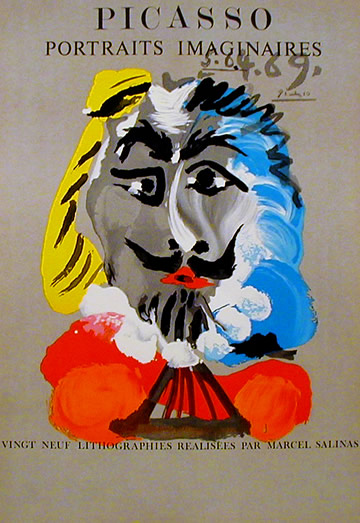
According to the Metropolitan Museum of Art in New York, "The artistic genius of Pablo Picasso (1881–1973) has impacted the development of modern and contemporary art with unparalleled magnitude. His prolific output includes over 20,000 paintings, prints, drawings, sculptures, ceramics, theater sets and costumes that convey a myriad of intellectual, political, social, and amorous messages. His creative styles transcend realism and abstraction, Cubism, Neoclassicism, Surrealism, and Expressionism." See Pablo Picasso (1881–1973) at: http://www.metmuseum.org/TOAH/HD/pica/hd_pica.htm .


Similarly, Encyclopedia Britannica reflects that,
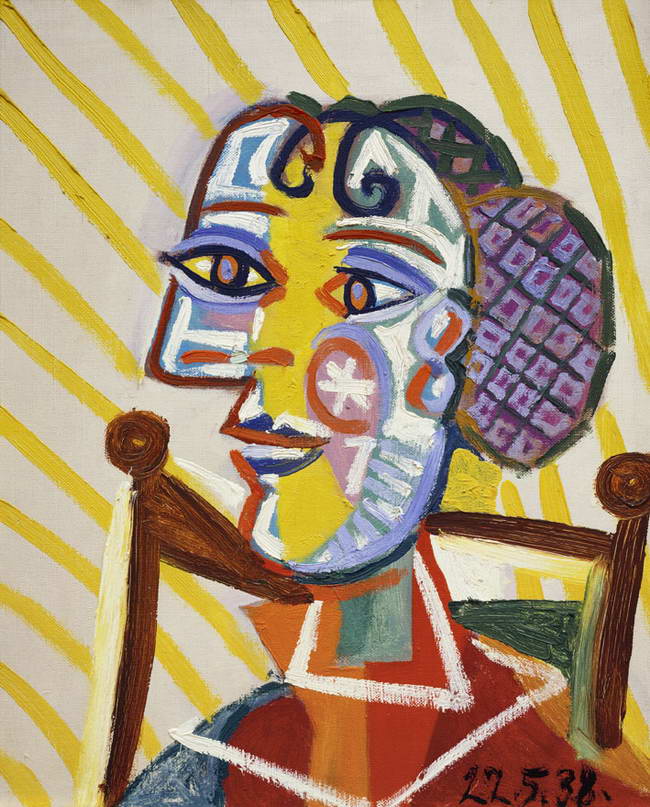

"Although Picasso never became an official member of the group, he had intimate connections with the most important art movement between the two world wars, Surrealism. The Surrealist establishment, including its main propagandist, André Breton, claimed him as one of their own, and Picasso's art gained a new dimension from contact with his Surrealist friends...

... Life and career » Surrealism


Although Picasso never became an official member of the group, he had intimate connections with the most important art movement between the two world wars, Surrealism. The Surrealist establishment, including its main propagandist, André Breton, claimed him as one of their own, and Picasso’s art gained a new dimension from contact with his Surrealist friends, particularly the
writers. Inherent in Picasso’s work since the Demoiselles were many elements that the official circle advocated. The creation of monsters, for instance, could certainly be perceived in the disturbing juxtapositions and broken contours of the human figure in Cubist works; Breton specifically pointed to the strange Woman in a Chemise (1913).


("In 1931, Universal Studios released the movie 'Frankenstein,' in which the monster as most of us recognise him today made his first appearance. The 1934 drawing appears to contain an inverted double portrait of Frankenstein's monster derived from this movie...

Picasso, who was often described as a monster, loved the cinema and probably saw the 1931 'Frankenstein' soon after its release in France. It appears clear from the drawing that he went on to identify a number of symbolic associations between himself and the monster and identified other symbolic associations between the monster and Hitler's Aryan Superman. Frankenstein's monster, like Oedipus and Picasso, were all in a sense responsible for the destruction of their fathers*. All three also Picasso symbolically, Oedipus by self infliction and suffered a form of blindness; Frankenstein's monster because at first his eyes were too sensitive to light. All three also underwent a form of crucifixion; Picasso symbolically, Oedipus when he is exposed by his father, the monster when he is created as well as when he dies under the sign of a burning cross. Finally, all three also experienced a form of exile; Picasso at the turn of the century in Paris and again in the 1930's as a protest against Franco, Oedipus by his own edict and the monster by being violently ostracised from the day of his creation." See Mark Harris, The Picasso Conspiracy, Symbolism in the 1934 Drawing - Frankenstein, at: http://web.org.uk/picasso/toc.html http://web.org.uk/picasso/symbolism.html http://web.org.uk/picasso/frankenstein.html ).


[IS GLOBAL WARMING SUCH A MONSTER??]


Moreover, the idea of reading one thing for another, an idea implicit in Synthetic Cubism, seemed to coincide with the dreamlike imagery the Surrealists championed.
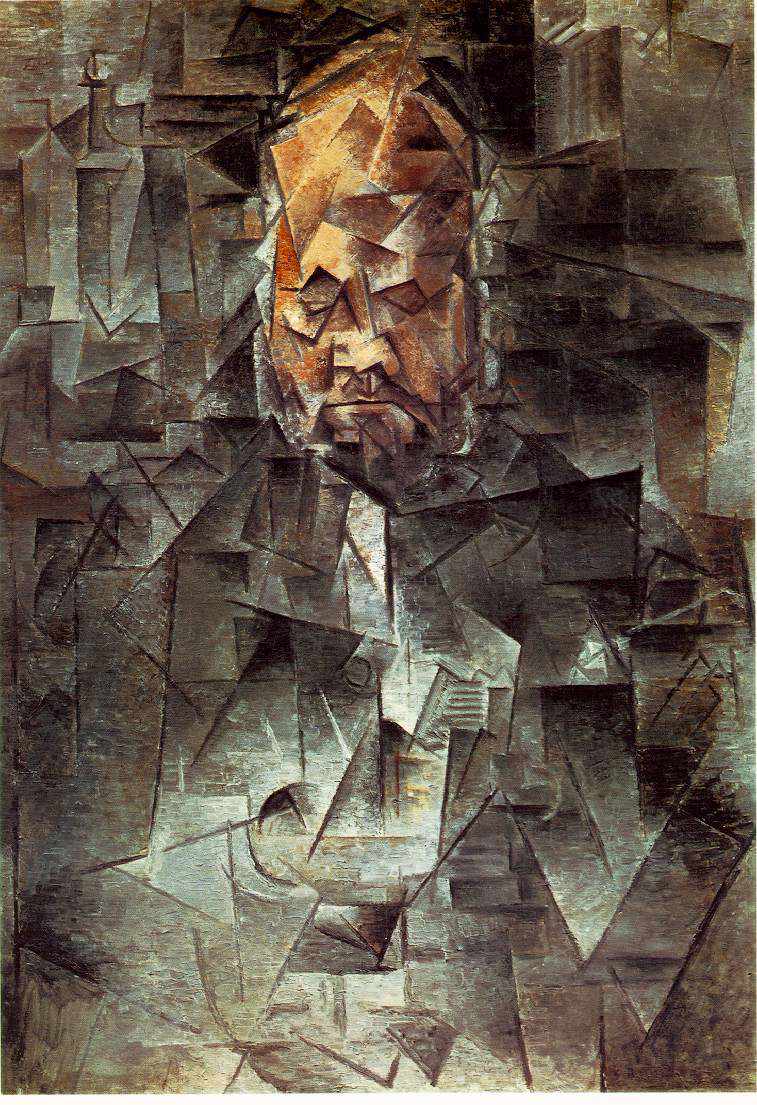

What the Surrealist movement gave to Picasso were new subjects—especially erotic ones—as well as a reinforcement of disturbing elements already in his work...the effect of distortion on the emotions of the spectator can also be interpreted as fulfilling one of the psychological aims of Surrealism (drawings and paintings of the Crucifixion, 1930–35).


In the 1930s Picasso, like many of the Surrealist writers, often played with the idea of metamorphosis.
For example, the image of the minotaur, the monster of Greek mythology—half bull and half human—that traditionally has been seen as the embodiment of the struggle between the human and the bestial, becomes in Picasso’s work not only an evocation of that idea but also a kind of self-portrait.


Finally, Picasso’s own brand of Surrealism found its strongest expression in poetry. He began writing poetry in 1934, and during one year, from February 1935 to the spring of 1936, Picasso virtually gave up painting. Collections of poems were published in Cahiers d’Art (1935) and in La Gaceta de Arte (1936, Tenerife), and some years later he wrote the Surrealist play Le Désir attrapé par la queue (1941, Desire Caught by the Tail).


...After the war Picasso resumed exhibiting his work, which included painting and sculpture as well as work in lithography and ceramics. At the Autumn Salon of 1944 (“Salon de la Liberation”) Picasso’s canvases and sculpture of the preceding five years were received as a shock. This plus the announcement that Picasso had just joined the Communist Party led to demonstrations against his political views in the gallery itself...


... Because Picasso’s art from the time of the Demoiselles was radical in nature, virtually no 20th-century artist could escape his influence. Moreover, while other masters such as Matisse or Braque tended to stay within the bounds of a style they had developed in their youth, Picasso continued to be an innovator into the last decade of his life."


See: Pablo Picasso, Surrealism, at Encyclopædia Britannica.com at: http://www.britannica.com/eb/article-59635/Pablo-Picasso ; and
http://www.britannica.com/EBchecked/topic/459275/Pablo-Picasso .

Tuesday, May 27, 2008

Could the Reports Claiming that Barack Obama has Communist Party Ties be True??


[This photo image of communist revolutionary Che Guevara is said to come from one of Barack Obama's campaign offices. Could this be true?

Research reveals that "Ernesto "Che" Guevara (May 14, 1928October 9, 1967), commonly known as Che Guevara, El Che, or simply Che, was an Argentine Marxist revolutionary, politician, author, physician, military theorist, and guerrilla leader. His stylized image also later became a countercultural symbol worldwide. As a young medical student, Guevara travelled through Latin America and was transformed by the endemic poverty he witnessed. His experiences and observations during these trips led him to conclude that the region's inequalities were a result of monopoly capitalism, neo-colonialism, and imperialism, with the only remedy being world revolution. This belief prompted his involvement in Guatemala's social revolution under President Jacobo Arbenz Guzmán, whose eventual CIA-assisted overthrow solidified Guevara’s radical ideology."


"Later, in Mexico, he joined and was promoted to commander in Fidel Castro’s 26th of July Movement, playing a pivotal role in the successful guerrilla campaign to overthrow the U.S.-backed Cuban dictator Fulgencio Batista.[1] After the Cuban revolution, Guevara served in many prominent governmental positions, including President of the National Bank and “supreme prosecutor” over the revolutionary tribunals and executions of suspected war criminals from the previous regime. Along with traveling to meet world leaders on behalf of Cuban socialism, he was a prolific writer and diarist: his published work includes a manual on the theory and practice of guerrilla warfare. Guevara left Cuba in 1965 to incite revolutions first in an unsuccessful attempt in Congo-Kinshasa and then in Bolivia, where he was captured with help of the CIA and executed."


[WHY WOULD BARACK OBAMA SUPPORTERS HANG A PICTURE OF CHE GUEVARA IN THEIR CAMPAIGN HEADQUARTERS?? WHAT KIND OF REVOLUTION DOES BARACK OBAMA CALL FOR???]


ELECTION 2008Report: Obama mentored by Communist Party figureInvestigations show ties to radicals who shaped him, helped launch his political career
Posted: May 22, 200811:40 pm Eastern


By Jerome R. Corsi


© 2008 WorldNetDaily


Barack Obama had extensive ties with extreme anti-American elements, including agents of the Moscow-controlled Communist Party USA, in Hawaii and Chicago, according to two new reports released yesterday in Washington, D.C., by two experienced internal security investigators.
Investigative journalist Cliff Kincaid and Herbert Romerstein, a former investigator with the U.S. House Committee on Un-American Activities, presented evidence Obama was mentored, while attending high school in Hawaii, by Frank Marshall Davis, an African-American poet and journalist who was also a CPUSA member.


The authors, in a separate report, document Obama's ties to radicals in Chicago who helped launch his career.

In a paper entitled "Communism in Hawaii and the Obama Connection," the authors document that in 1948, Davis decided to move from Chicago to Honolulu at the suggestion of what they describe as two "secret CPUSA members," actor Paul Robeson and Harry Bridges, the head of the International Longshoremen's and Warehousemen Union, or ILWU.

In Chicago, Davis had worked for the Chicago Star newspaper; in Honolulu, he was hired as a reporter for the Honolulu Record, both identified by Kincaid and Romerstein as "communist front newspapers."


In his autobiography, "Dreams from My Father," Obama discusses the influence a mentor identified in the book only as "Frank" had on his intellectual development.
Obama described Frank as a drinking companion of his grandfather, who had boasted of his association with African-American authors Richard Wright and Langston Hughes during the time Frank was a journalist in Chicago.


Romerstein, in addition to having served as investigator with the U.S. House Committee on Un-American Activities, served in the same capacity with the House Committee on Internal Security and the House Permanent Select Committee on Intelligence. He was the head of the Office to Counter Soviet Disinformation for the U.S. Information Agency. Romerstein is also co-author of the influential book "The Venona Secrets: Exposing Soviet Espionage and America's Traitors," which included extensive documentation of the communist activities of Roosevelt administration staffer Alger Hiss.

Kincaid is the founder and president of America's Survival Inc., an independent watchdog group that monitors the U.N. and international terrorism. He is also editor of Accuracy in Media's AIM Report.
Are you a member of the Communist Party?

Kincaid and Romerstein quote Kathryn Takara of the University of Hawaii, who wrote a dissertation on the life of Frank Marshall Davis, confirming Davis was a significant influence on Obama when the senator attended Punahou prep school in Hawaii from 1975 to 1979
A transcript of a 1956 hearing before the Senate Internal Security Subcommittee discovered by internal security affairs researcher and writer Max Friedman showed Davis took the Fifth Amendment when asked by the subcommittee if he was or had ever been a member of the Communist Party.


In the second report, "Communism in Chicago and the Obama Connection," Kincaid and Romerstein present evidence supporting their contention the SDS organization from which the Weather Underground organization and radicals Bill Ayers and Bernardine Dorhn came, received financial contributions from the CPUSA, which in turn receive its funding from Moscow.

Obama's run for the Illinois state Senate was launched by a fundraiser organized at Ayers' and Dorhn's Chicago home by Alice Palmer. Palmer had named Obama to succeed her in the state Senate in 1995, when she decided to run for a U.S. congressional seat.

Nine years before Palmer picked Obama to be her successor, she was the only African-American journalist to travel to the Soviet Union to attend the 27th Congress of the Communist Party of the Soviet Union, according to an article Palmer wrote in the CPUSA newspaper, People's Daily World, June 19, 1986.

"There has been no explanation of why Ayers et al. played a role in launching Obama's political career," Kincaid wrote.

Kincaid and Romerstein present documentation that Tom Hayden, another major figure in the SDS, is today one of four principal initiators of the "Progressives for Obama" movement, which calls for ending the war in Iraq "as quickly as possible, not in five years."

According to Kincaid and Romerstein, U.S. Peace Council executive committee member Frank Chapman "blew the whistle on communist support for Obama's presidential bid and his real agenda" in a letter to the People's Weekly World after Obama's win in the Iowa Democratic Party caucuses.

"Obama's victory was more than a progressive move; it was a dialectical leap ushering in a qualitatively new era of struggle," Chapman wrote. "Marx once compared revolutionary struggle with the work of the mole, who sometimes burrows so far beneath the ground that he leaves no trace of his movement on the surface.

Kincaid and Romerstein wrote, "The clear implication of Chapman's letter is that Obama himself, or some of his Marxist supporters, are acting like moles in the political process. The suggestion is that something is being hidden from the public."